
The planting in an EcoShield absorbs the overpressure from a bomb blast, reducing blast impact on people on the other side.
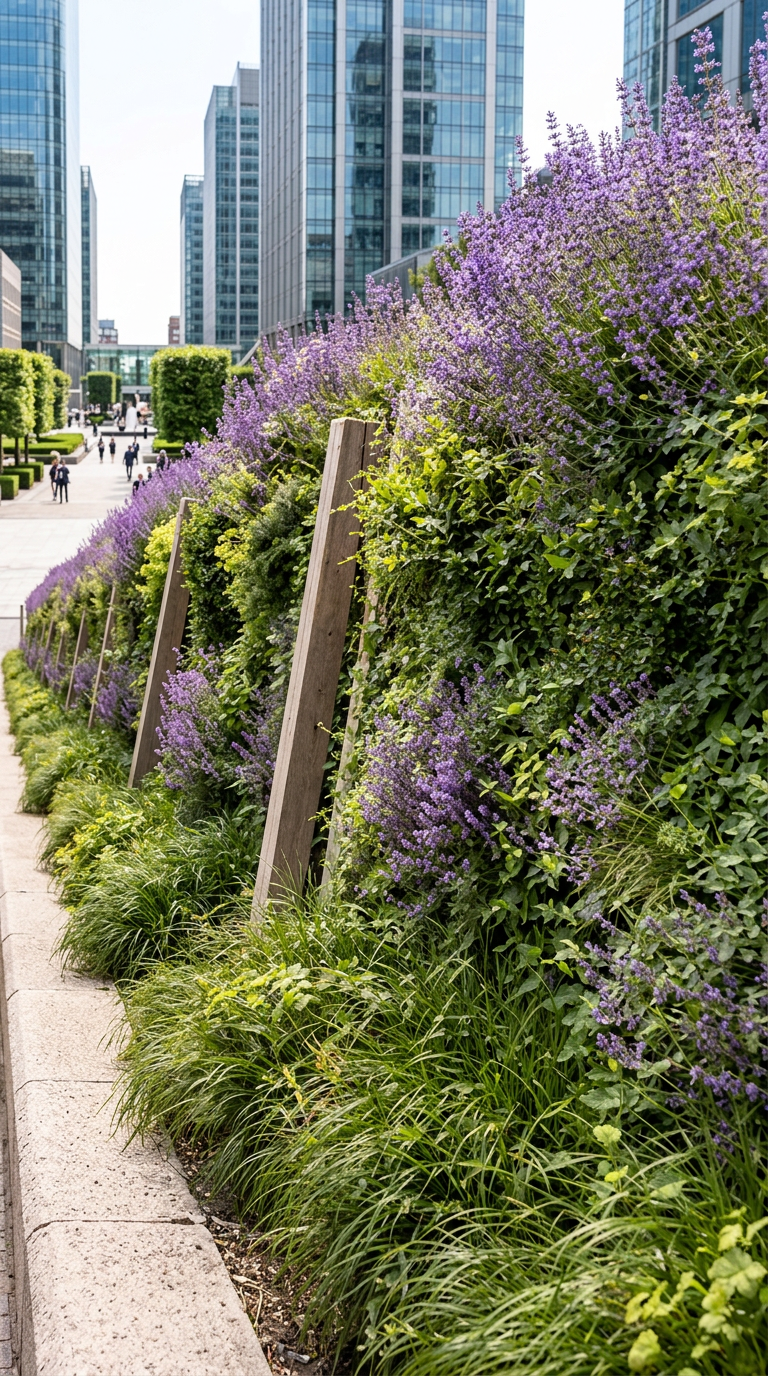
An EcoShield is a bank of dense planting with an engineered structure inside it, designed for the site it stands on rather than ordered from a catalogue. It looks like landscape because it is landscape.
How can planting reduce a blast?
The wave passes into dense living material and its energy is taken up there rather than carried on, so what comes out the other side is a weaker wave.
That absorption is the whole of the effect. Less force reaches the people who would otherwise be standing directly in harm’s way, and it is achieved without a hard surface, which would send the wave back towards the crowd beside it.
It is engineered to exploit multiple methods of blast dissipation including biomass loading, impedance mismatch and materials failure.
Biomass loading is living material doing the work that concrete and heavy steel do in a conventional barrier. Impedance mismatch is the wave crossing between materials of very different density, scattering and weakening as it goes. Materials failure is foliage breaking under load, which accounts for part of the energy absorbed.
None of this is our idea alone. The blast-mitigating potential of dense planting has been examined in the peer-reviewed literature, in Landscape and Urban Planning and in related work on trees as protective barriers. What is ours is four years of experimental validation at Cranfield University turning that into something a site can actually be designed around.
Why can a solid wall make things worse?
A wall reflects. The wave arrives, meets a surface that will not move, and a large part of the energy comes back off it. Close to the wall the pressure a person experiences can be higher than it would have been in open ground.
Protective engineers know this trade well. It is why hard barriers are placed and specified with such care. It is also why a measure that takes energy in is not interchangeable with one that sends it back, on a site where people stand close to the boundary.
What is an EcoShield made of?
A dense run of planting with an engineered structure inside it. The planting is specified for the site, the climate and the maintenance regime the site can realistically sustain. The structure is what turns a bank of planting into a designed protective measure with a stated performance envelope.
We design it, specify it and assure it. The planting, the installation and the maintenance are carried out by our partners to that specification, so what stands on the site is what was designed, and it stays that way.
Is an EcoShield a vehicle barrier?
No. An EcoShield is designed to mitigate the effects of person-borne explosive threats in public environments. Vehicle mitigation is a different problem with its own established answers, and many of the sites we talk to already have it.
It is also not decorative planting with a security story attached. The difference is the engineering inside it and the assurance behind it, and that difference is the whole of the product.
Does an EcoShield enclose a site?
No. It is not a fence, and it is not there to stop anyone getting anywhere. It stands where the pressure would travel, so that less of it reaches the people on the other side.
That is why an EcoShield has gaps in it. People walk through and carry on down the street, and the street works the way it did before.
How much does an EcoShield cost?
Every EcoShield is priced for its site.
The cost depends on the threat being designed against, the length and geometry of the EcoShield, the planting the site can sustain and the ground it stands on, so it is set for each site rather than taken from a rate card.
The commercial shape is a design fee, then planting and installation carried out by our partners, then maintenance and assurance over the life of the asset.
You will have an indicative range for your site by the end of the first call, and a full proposal follows a site assessment.

The methodHow an EcoShield is designed
Step 1Understand the threat and the site
We start with what could realistically happen here: the kind of device, how it would arrive, and where people would be standing when it went off. We look at that alongside the security the site already has, its bollards, its hardened structures, its procedures on the day, because an EcoShield is one part of that plan, not a replacement for it.
Together, those tell us where an EcoShield is needed and what it has to stand up to.
Step 2Agree what it has to do
Before anything is designed, we agree with you what the EcoShield needs to do. Part of that is protection: how much of the pressure from a blast it has to absorb before that pressure reaches people. The rest is practical. It has to fit how the site runs from day to day, and it has to be affordable to look after for years.
Those practical points shape the design as much as the threat does. Settling them at the start means what gets built is something the site can live with, not just something that works on paper.
Step 3Design it, build it right, keep it right
We then design the EcoShield for that site: its length and shape, the planting, the structure inside it, and the protection it is designed to give.
We set out exactly what is to be built, check that it was built that way, and say how it is to be kept in the condition the design assumed, because planting only protects people if it stays as it was designed.
Talk it through against a real site
Thirty minutes. What you are protecting, what the site allows, who signs it off, and whether anything is forcing a decision.